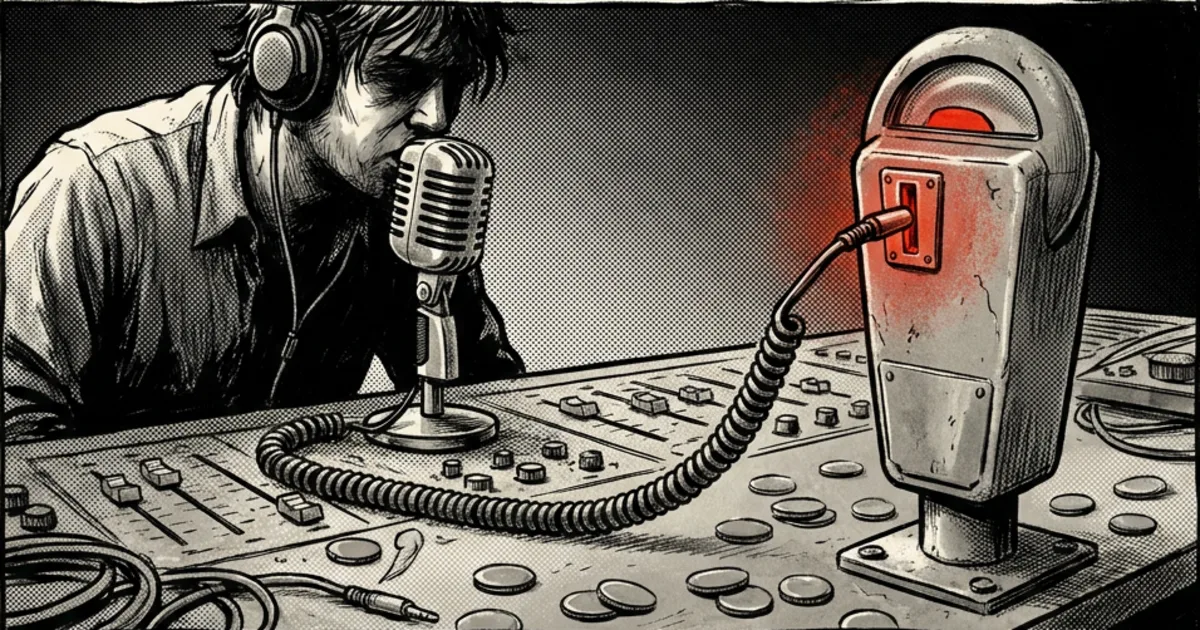
TL;DR: ElevenLabs still sets the bar for finished narration, and Eleven v4, out since September 28, tops an independent blind-vote leaderboard. The catch is the meter: you pay per generation, not per download, so every bad take goes on the tab. Creator at $22 a month is the sensible first paid step, the first tier with a professional clone and 192 kbps audio; for bulk plain narration, skip the app and hit the API or a cheaper vendor.
Four hosts on my internet radio station, and not a one of them has lungs. Every spoken voice on GZS Radio that isn’t mine comes out of ElevenLabs, and some of the ones that are mine do too, by way of a clone.
Small scripts push the DJ links, station IDs, top-of-hour time checks and short news reads through the API, so the settings below aren’t theory to me. The billing page is the part that needs a translator.
Everything here comes from ElevenLabs’s own pages as of October 25, 2026. They change fast. Check the links before you pay.
ElevenLabs models in 2026: start on v4, then test it against v3 and v2
ElevenLabs started as text-to-speech and grew into a whole audio shop: cloning, dubbing, a voice changer, sound effects, music, transcription, phone agents. For speech, the call you actually make is which of five models reads your script.
| Model | ID | Pick it for | Per-request limit |
|---|---|---|---|
| Eleven v4 | eleven_v4 |
Finished narration, character voices, audiobooks | 10,000 chars (about 10 min) |
| Eleven v4 Turbo | eleven_v4_turbo |
Live agents, about 100 ms median inference | not listed |
| Eleven v3 | eleven_v3 |
Dramatic delivery, multi-speaker dialogue | 5,000 chars (about 5 min) |
| Multilingual v2 | eleven_multilingual_v2 |
Steady voiceover, numbers read properly | 10,000 chars (about 10 min) |
| Flash v2.5 | eleven_flash_v2_5 |
Cheap and fast, about 75 ms | 40,000 chars (about 40 min) |
Source: the models page. Languages: v4 and v4 Turbo 90+, v3 70+, Multilingual v2 29, Flash v2.5 32.
The docs now label Multilingual v2 a previous-generation model. Every script on my station still calls it, and on the API it’s billed at the same $0.08 per 1,000 characters as v4. Studio, the long-form editor, defaults to it for new projects.
New to it? Start on v4, then A/B it against v3 and v2 with your own voice and your own script. The docs tell you to. A v4 clone can sound noticeably different from its v3 version, and the model’s under continuous development, so the read you approved this month may not be the read you get next month.
The same page says v4 exposes only Stability and Similarity. No Style or Speed slider. No SSML either.
How much does ElevenLabs cost, and what do the credits buy?
Six self-serve plans run from $0 to $990 a month, and the working rule is about 1,000 credits per minute of finished speech. On Multilingual v2 and v3 in the app, one character is one credit. The pricing page says the exact cost depends on the model and publishes no separate v4 rate, just the minutes column below:
| Plan | Price | Credits / month | About minutes | Extra minute | What changes |
|---|---|---|---|---|---|
| Free | $0 | 10,000 | 10 | $0.36 | No commercial license |
| Starter | $6 | 30,000 | 30 | $0.20 | Commercial license, instant cloning |
| Creator | $22 | 121,000 | 121 | $0.18 | Professional cloning (1 slot), 192 kbps |
| Pro | $99 | 600,000 | 600 | $0.17 | 44.1 kHz PCM via API |
| Scale | $299 | 1.8M | 1,800 | $0.17 | 3 PVC slots, 3 seats |
| Business | $990 | 6M | 6,000 | $0.17 | 10 PVC slots, 10 seats |
Annual billing works out to ten months for twelve ($220 a year for Creator, $990 for Pro). Starter and Creator both show a first-month promo banner (Starter’s runs until November 1), so the number at checkout isn’t the number you’ll pay in month two.
The page lists an extra-minute rate on every plan, but “Additional Credits” only shows up as a feature from Creator up. On Free and Starter that figure may be a sticker with nothing behind it. Don’t budget on it.
The traps, in the order they’ll bite you:
- Credits are charged per generation, not per download. The pricing page says so in plain words. A take you hate costs exactly what a keeper costs. It’s a studio that bills for every take on the reel and doesn’t give a shit which one you keep.
- Free re-rolls are narrow. In Studio you get two free regenerations of a paragraph if text, voice and voice settings are unchanged. On the website’s text-to-speech box it’s two, if text, voice and model are the same, within two hours, with no page refresh. The API? None.
- Rollover is limited and dies with a cancel. Unused credits roll over up to two months’ worth, the balance can reach 3x your monthly quota, and a cancel or downgrade forfeits what’s left.
- Some Library voices cost more. The help center says some shared voices carry a credit multiplier, flagged with a tag in the Library. It calls the custom-rate feature legacy and doesn’t publish the numbers.
- The refund window is bullshit. You can get money back within 14 days of payment only if no credit quota was used in that period. Testing a paid plan means using credits, so who exactly is that window for? Test on Free.
Other tools run on their own meters. Per the pricing FAQ: speech-to-text is 330 credits a minute, music 900, sound effects 200 a generation, voice changer and voice isolator 1,000 a minute.
Dubbing’s where it gets ugly. The FAQ says 2,000 to 10,000 credits a minute, depending on whether you use automatic or Dubbing Studio and whether you want the watermark gone. At that top rate, a Creator month buys about twelve minutes of no-watermark Dubbing Studio output.
The plan table’s own tooltip is newer and higher: automatic Dubbing v2 at 13,500 credits a minute on paid plans, which is about nine minutes of Creator credits. Two of their own pages can’t agree on what a dub costs, which is a hell of a thing for a company that bills by the credit. Check the price shown before you start a dub.
Is the ElevenLabs API cheaper than the app?
Yes. The API hands you roughly twice the characters per dollar of the app, and that’s the biggest discount I found on self-serve.
The API pricing page lists v4, v3 and Multilingual v2 at $0.08 per 1,000 characters, and v4 Turbo, v3 Conversational and Flash/Turbo at $0.04. On Creator, the same $22 buys 121,000 app credits or 275,000 API characters. On Pro, $99 buys 600,000 credits in the app or 1,238,000 API characters.
At the page’s own ratio of about a thousand characters a minute, that’s roughly eight cents a minute on the expensive models and four on the cheap ones.
Divide any paid tier’s price by its included characters and you’ll get $0.08 per 1,000 every time. Higher tiers sell concurrency, seats, cloning slots and audio formats. The self-serve rate stays flat, though the Business plan advertises low-latency TTS from 5 cents a minute, and Enterprise advertises discounts at scale.
You give up the workshop on the API: Studio, paragraph history, the free regenerations. You get scripts that render a station’s worth of links with nobody clicking anything.
My scripts output 44.1 kHz, 128 kbps mp3, which every plan includes, Free too. The 192 kbps option starts at Creator.
The station runs on a tight budget, so the spoken links stay short on purpose and the credit spend stays trivial. Short copy through the API is ElevenLabs at its cheapest.
Flip it around. Put a novel through the app, re-roll every paragraph that reads wrong, and the meter stops being a rounding error and starts being rent.
ElevenLabs voice cloning: the professional clone only works on your own voice
Four ways to get a voice. Library voices come ready-made, Voice Design builds one from a text prompt, an instant clone copies a voice from a minute or two of audio, and a professional clone trains on 30 minutes to three hours of it. That last one, the good one, works only on your own voice.
- Library voices. Saved Library voices don’t use a custom voice slot. Lily, one of my four hosts, is a stock voice, and River, the pleasant calm voice I use for faceless-video narration, comes from the library too. Voices shared by other users have owners: under the Voice Library addendum, if the owner pulls one, people who added it keep access only until the end of the notice period the owner chose.
- Voice Design. Describe a voice and you get three previews per prompt. You pay for the preview text once, and saving one takes a voice slot. The Signal Keeper and The Custodian both started as Voice Design prompts in early June 2026. The docs call Voice Design experimental and say words like reverb and echo hurt the output, so describe the person, never the room. Designed voices work on v4 but may come out less performative.
- Instant clone. Starter and up. The docs recommend one to two minutes of clean audio, minimum 10 seconds total, and say going past three minutes gains little and can hurt. It’ll copy the hum of your fridge as faithfully as your voice, and you can’t export a clone as a file.
- Professional clone. Creator and up, one slot there, three on Scale, ten on Business. You’ve got to verify your voice first, and the docs say you can only make one of your own voice, even if somebody consents to you cloning theirs. They’ve got to make and verify their own and share it. Drop below Creator and the PVC sits unusable in your account. Already got one? It has to be fine-tuned again to run on v4.
Cloning consent. The Prohibited Use Policy, last updated October 9, 2026, requires “explicit and informed consent” to clone a living person’s voice. It also bans training on recordings of minors, impersonation, stripping watermarks, and political campaigning without ElevenLabs’s prior written consent, and it requires AI disclosure where silence would mislead.
Commercial rights follow the plan. Free has no commercial license, and anything published from it needs “elevenlabs.io” or “11.ai” in the title, a billboard stapled to your work. Paid plans include one, with an exception for Beta services.
The help center adds the line that bites people in the ass: content made during a paid subscription is commercially usable indefinitely, and content made outside one isn’t.
Don’t generate on Free and upgrade the day you publish. Pay first. Then render what you ship.
ElevenLabs voice settings: what I actually run on air
Two sliders matter most: Stability and Similarity. Speed is the cheap fix for a rushed read, Style and Speaker Boost are seasoning, and the v4 page lists none of those three.
Every slider sets a range of randomness. None of them buys you the same read twice.
What I run on Multilingual v2, next to what ElevenLabs’s own guidance says:
- Stability 0.45 to 0.5 for the hosts who should sound human. ElevenLabs defaults to 50. Lower gets a wider emotional range and can turn odd and random. Higher goes monotonous.
- Stability 1.0 on The Custodian, on purpose. That’s the monotone the docs warn you about. I want it. The Custodian is supposed to sound flat and machine-like.
- Similarity 0.75, one batch at 0.8. Around 75 is the usual setting. A high value on poor source audio reproduces the artifacts.
- Style 0 on most, one batch at 0.35. ElevenLabs says keep it at 0 at all times; above 0 it costs extra compute and makes the model slightly less stable.
- Speed 0.93 to 0.98. Default pacing sounds rushed on radio. The range is 0.7 to 1.2, and extremes can hurt quality.
- Speaker Boost on. Subtle effect, small latency cost.
The v4 migration catch. Speed’s the knob I lean on for the radio read, and one batch ran Style. The v4 page says neither exists on v4. If I moved the station over tomorrow, the fix for that rushed read would just be gone. (Another docs page contradicts itself on Speed, so test it.)
On v4 you steer with audio tags in square brackets and with punctuation: ellipses add pauses, capitals add emphasis. Tags land best when the voice was trained on that delivery. A tag can also get taken as a sound-effect cue instead of a delivery, and the docs warn that a serious voice may not respond well to playful ones.
SSML break tags don’t work on v4 or v3. On older models they do, up to three seconds, and too many in one generation cause speed changes and artifacts.
Where ElevenLabs breaks: names, numbers, drift and your balance
It breaks where a listener notices first, on a surname or a price. None of it’s fatal. You pay for every fix.
- Pronunciation. Dictionaries (TXT or PLS, alias or phoneme rules) work in Studio and Dubbing Studio. Matching is case-sensitive and only the first matching entry applies. Phoneme tags work on Flash v2 only, so on Multilingual v2 you respell the word or use an alias. v4 takes IPA between forward slashes, and the docs admit results still vary by voice. Test every proper noun with the voice you picked.
- Numbers and currency. Multilingual v2 reads them better than Flash v2.5, which doesn’t normalize by default. Expand abbreviations and write out figures before you send the text, with a regex or an LLM pass. Phone numbers and prices? That’s where it’ll embarrass you.
- Take-to-take drift. Same voice, same settings, same text, slightly different read. Fine for one link, maddening when two IDs have to match, and every tuning regeneration is billed. Chop long copy into pieces under the model’s limit, and use Studio for anything book-length.
- Emotional range. ElevenLabs admits audio-tag following isn’t perfect yet. A voice that never whispered in training may not whisper just because you typed a tag at it, and you pay for every take where it doesn’t.
- Accent handling on v4. When the output language differs from the reference voice’s language, v4 aims for fluent native-sounding speech and drops the reference accent. The vendor says a toggle is a research project with no timeline. Don’t promise a client their accent survives dubbing.
- Sameness on v4. One recent Reddit thread has a user saying v4 voices, their PVC included, all share the same cadence and inflections. It’s one user’s report, and I haven’t tested it. Check it yourself.
ElevenLabs vs Fish Audio, Cartesia and OpenAI: best voices, biggest bill
ElevenLabs wins the one independent quality ranking I could find, and everybody undercuts it on price.
The Artificial Analysis voice arena pits each provider’s own native voices against each other in blind listener votes. It has Eleven v4 Turbo first (Elo 1336, $40 per million characters) and Eleven v4 second (1332, $80), and the two share the top rank because their confidence intervals overlap.
Cartesia’s Sonic 3.6 is fourth at 1292. Fish Audio’s Drama 3 Preview is ninth at 1248, at $15 per million.
| Option | Entry price | What it buys | Rough cost per minute |
|---|---|---|---|
| ElevenLabs v4 API | $0.08 per 1K chars | Top-ranked voices, Library, Studio | about $0.08 |
| Fish Audio | Plus $11/mo billed annually ($15 monthly) | 250,000 credits, up to 200 min, commercial use, cloning | about $0.055 annual, $0.075 monthly |
| Cartesia | Pro $5/mo | 100K credits at 750 to 800 per minute, commercial license, instant cloning | about $0.04 |
| OpenAI TTS | tts-1 $15 per 1M chars, shutting down Jan 6, 2027 | A voice API, no studio | about $0.015 |
The per-minute column is my arithmetic from list prices, using ElevenLabs’s own thousand-characters-a-minute ratio for the per-character rates. Read Fish Audio’s Free plan twice: the plan page lists commercial use while the FAQ limits free users to non-commercial projects.
Cartesia’s $5 Pro is the cheapest commercial license here. OpenAI lists tts-1 as deprecated and points to a Realtime model that isn’t billed per character, so tts-1 is a dead voice walking for this job.
I haven’t run any of these three on air. The table is list prices, and a list price can’t tell you what a voice does to a surname.
My read: Fish Audio at roughly 70 to 95 percent of the cost, depending on billing, is worth a trial if you’re cloning on a budget. You’re paying the ElevenLabs premium for the Library, Studio and the top-ranked model.
Which ElevenLabs plan to buy, and who should skip it
Match the tier to the job. Start on Free every time.
- Just trying it: Free. Ten minutes, no commercial use, attribution in the title. Spend them on the copy you’re scared of.
- Faceless shorts or a side-project voiceover: Creator. You get the commercial license, 192 kbps, 121 minutes and one professional clone. Starter ($6, 30 minutes) works if you can live with 128 kbps and a stock voice.
- Audiobook or long narration under your name: Creator or Pro, in Studio, with v4 tested against v3 on your own voice. Budget for generating every paragraph more than once; the pricing page publishes no re-take multiplier, so I won’t invent one. Pro’s 600,000 credits is about ten hours of speech before re-takes.
- Radio, automation, bulk plain narration: the API and short scripts, which is how I run the station. Then take a hard look at Fish Audio and Cartesia.
- Dubbing: price it in finished minutes before you promise anyone a damn thing.
- Scale ($299) and Business ($990): only for seats, concurrency or clone slots.
- Skip it: if all you need is cheap, forgettable narration at volume. Cartesia’s $5 Pro runs about four cents a minute, and OpenAI’s tts-1 lists $15 per million characters, less than a fifth of the v4 API rate, though OpenAI is shutting tts-1 down on January 6, 2027.
Frequently asked questions
Is ElevenLabs free?
There’s a Free plan with 10,000 credits a month, about ten minutes of speech, and it carries no commercial license. If you publish anything made on it, or made while logged out, the title has to include “elevenlabs.io” or “11.ai”.
How much does ElevenLabs dubbing cost?
The pricing FAQ lists 2,000 to 10,000 credits per minute of output, depending on automatic versus Dubbing Studio and whether the watermark is removed. Through the API, dubbing v1 is $0.33 a minute with a watermark and $0.50 without, and Dubbing v2 is $2.20 a minute.
Can I use ElevenLabs voices commercially?
On any paid plan, yes, with one exception: output from Beta services can’t be used commercially or in production. Content you generate during a paid subscription stays usable commercially indefinitely. Content generated outside a paid subscription, on Free or logged out, never becomes commercial. You’ll also need the rights to whatever text you feed it.
Does ElevenLabs have an API, and what does it cost?
Yes, and it’s the cheaper route. List rates are $0.08 per 1,000 characters on v4, v3 and Multilingual v2, and $0.04 on v4 Turbo, v3 Conversational and Flash/Turbo, at every subscription tier.
Is ElevenLabs better than Fish Audio?
For voice quality and tooling, ElevenLabs ranks higher on the Artificial Analysis blind arena, and it has a Voice Library and Studio, a long-form editor. Fish Audio is cheaper: Plus is $11 a month billed annually ($15 billed monthly) for 250,000 credits, up to 200 minutes, with commercial use. If you’re cloning on a budget, test Fish Audio against your actual script first.
Can I clone someone else’s voice with ElevenLabs?
Only with their explicit and informed consent for an instant clone, and not at all for a professional clone. The professional clone’s limited to your own voice, even if the other person agrees; they have to create and verify their own and share it with you.
Give the free tier the worst paragraph you’ve got, a surname nobody spells right and a price with cents on it, and hear it trip over them while the tripping’s still free.
To run that test, start with the free plan here: ElevenLabs signup. That's an affiliate link: if you pay, I earn a commission, and you pay the same.
Comments are open to members. Sign up free →